
Federal Lumpkin Release Paths
The Lumpkin jail system contains held-for-agency values for federal authorities, USMS, and ICE. Those values show that a county record can describe an agency relationship or transfer. They do not prove a standing federal detention contract, and they do not mean there is a federal prison in the county.
When the release reason names USMS or ICE, the county booking has ended but custody may continue. For a sentenced federal person, BOP becomes the durable locator. For federal pretrial custody, a court docket or Marshals channel may be needed before BOP has a designated facility record. For immigration custody, use ICE’s official locator. Always obtain the county receiving-agency field before deciding which branch applies.
Confirm a BOP Release
Use the BOP inmate locator for federal prisoners from 1982 forward. Search by name or a known federal register number, then read the release date with the facility field. BOP explains that a past release date and no facility location mean the person is no longer in BOP custody. Another legal status may still exist.
- Search the full name and compare age or identifier details.
- Open the matching federal record.
- Read the date and facility location together.
- Recheck later if sentence credits may cause recalculation.
- Use federal court records when a USMS prisoner has not reached BOP.
The Lumpkin County release search remains the source map for the local booking that preceded the federal transfer.
Check an ICE Transfer
The ICE Online Detainee Locator covers current or recent immigration detention, not the local jail’s release record. USA.gov explains two search routes: A-number, or name with country of birth and date of birth. A county record that says ICE confirms departure from Lumpkin custody. ICE records address the next stage.
Official Federal Channels
BOP: sentenced federal custody and release dates
USMS: many federal pretrial and transport stages
ICE: current or recent immigration detention
County record: local release reason and receiving agency
An ICE search with no result does not prove community release. Spelling, identity fields, processing delay, or a custody change can affect the result. Use official ICE channels and the federal or immigration court record for follow-up. Do not infer federal status from nationality, charge wording, or a missing county roster entry.
Lumpkin Release Record Fields
A release record does more than show that a name vanished from the roster. It ties the end of a booking to a reason and, where applicable, a destination. That distinction prevents a move to another custodial system from being mistaken for freedom from custody.
| Field | What it establishes |
|---|---|
| Booking and release time | The start and end of the local custody event |
| Release reason | Bond, court action, time served, sentence completion, or transfer |
| Bond information | Whether bond was the release route and what type applied |
| Holding agency | Which agency had an interest in the custody event |
| Receiving agency | Whether custody continued with GDC, USMS, ICE, or another jail |
Charge data is not the same as a conviction. The court file remains the better source for disposition. Likewise, a jail release date does not by itself show whether parole, felony probation, municipal probation, or another obligation followed.
USMS Transfer Record Limits
A person in federal pretrial custody may not appear promptly in BOP because BOP generally becomes the key system after designation or sentencing. If the Lumpkin release record names USMS or “federal,” check the federal court docket, official Marshals contact, and later BOP records. Describe the local event as a transfer unless a source clearly says custody ended.
This distinction also guards against reading a BOP “not in custody” result too broadly. It means no current BOP custody under that record, not that there is no supervision, warrant, immigration process, state hold, or other custodial status. Match identifiers and use the originating record. Federal, state, and county systems do not form one combined roster.
Lumpkin Federal Detainer Meaning
A detainer asks a current custodian to hold or notify another agency under the applicable authority. It does not itself prove that a federal transfer occurred or that the person entered BOP or ICE custody. Request the actual release reason and receiving agency from the Lumpkin booking.
Georgia immigration-reporting context does not establish a local ICE detention contract. No federal prison or ICE detention center was identified in Lumpkin County. The practical check remains record based: county documentation for the departure, BOP for a sentenced federal prisoner, a federal docket or USMS channel for pretrial custody, and the ICE locator for immigration detention. Avoid describing a transfer as community release until the next agency’s status is known.
Lumpkin Court Release Proof
Court records often supply the reason behind a local release. Superior Court holds felony criminal files. Magistrate Court handles warrant applications, certain misdemeanors, and good-behavior bonds. Dahlonega Municipal Court covers city misdemeanor, traffic, and ordinance matters. A bond order, dismissal, sentence, or other disposition may remain accessible after the live custody entry disappears.
Match the court to the charge and arresting agency rather than assuming every matter belongs in one clerk’s office. A court order can authorize release, while the jail record shows when the order was carried out. Both records may be needed when dates differ because processing took time or another hold remained. Municipal probation is also distinct from felony supervision through the Georgia Department of Community Supervision.
Federal Release Search Limits
Federal, immigration, state, and county systems do not form one combined roster. Keep the register number, exact name spelling, and date shown in a BOP result. Federal release dates can be recalculated as credits are applied, so a future date deserves another check. For ICE, retain the A-number when lawfully available because it is stronger than name alone.
The BOP records explanation defines how to read its past release dates.
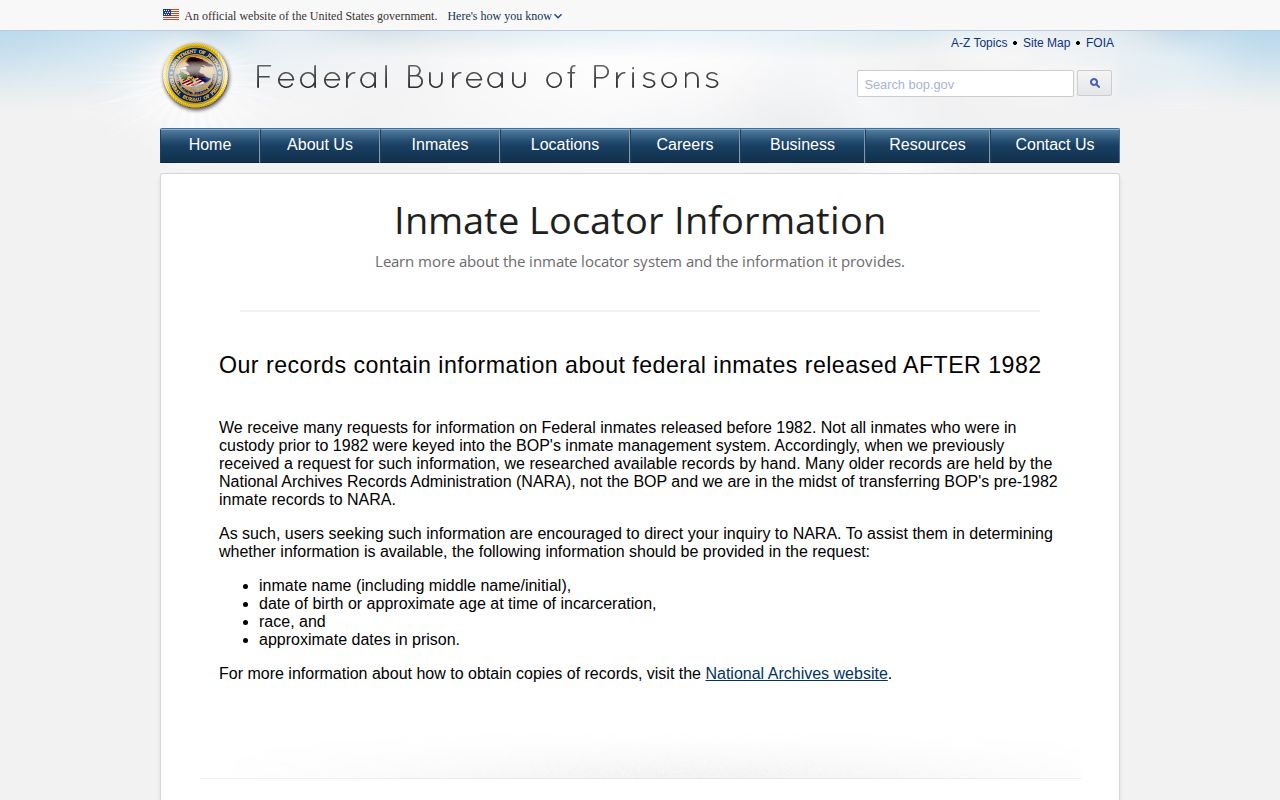
The captured BOP source supports a federal conclusion only. It does not settle immigration detention, supervision, a state hold, or the original Lumpkin County booking.
Build the timeline from separate records. The Lumpkin booking states when county custody ended and may name the receiving agency. A federal docket can explain a USMS transfer. BOP covers a sentenced federal term, while ICE covers immigration detention. If dates overlap, do not force them into one release event. The person may have passed directly between custodians.
Compare the register number or A-number when available, birth details, and the known case. Common names are not enough. Save the date of each search and confirm urgent status through the agency that currently owns the record.