
Lumpkin Parole Versus Probation
Both statuses allow a person to live in the community under conditions, but their legal sources differ. DCS supervises Georgia felony parolees and probationers in the field.
| Status | Who imposes it | Best verification |
|---|---|---|
| Parole | State Board of Pardons and Paroles after confinement | Parolee Search, Board records, and DCS |
| Felony probation | Sentencing court | Court sentence and DCS office |
| Municipal probation | Dahlonega Municipal Court | Court and its listed local provider |
- Parole
- Conditional release from state confinement before sentence expiration.
- Probation
- A court sentence served under community conditions.
- Absconder
- A supervised person alleged to have stopped reporting or left supervision without approval.
- Discharge
- Formal completion or termination of supervision.
Check Lumpkin Post-Release Supervision
Use the system that created the status. A local bond release is not parole. A prison transfer is not community supervision.
- Search the Georgia Parolee Search for a person believed to be on parole.
- If the person is still incarcerated, check the TPM Lookup. A tentative parole month is not a release date.
- Read the Lumpkin Superior Court sentence for probation, a split sentence, or revocation terms.
- Contact the Dahlonega DCS office to confirm the local supervising office where disclosure is permitted.
- For a city misdemeanor or ordinance case, use Dahlonega Municipal Court and its municipal probation contact, not the felony DCS path.
Match identifiers and court facts, not just a common name. The Lumpkin released-inmate search explains how to distinguish county, state, and transfer records.
Lumpkin Supervision Office in Dahlonega
The DCS Dahlonega field office serving Lumpkin County is local rather than in a distant regional center. It serves the Enotah Circuit and Lumpkin, Towns, Union, and White counties.
Georgia Department of Community SupervisionDahlonega Field Office
163 Tipton Drive
Dahlonega, GA 30533
Phone: 706-867-2929
Fax: 762-245-2125
Monday-Friday, 8 a.m.-4:30 p.m.
Office staff can identify reporting and office-routing information within applicable disclosure limits. They do not replace the court for copies of the sentence or the Board for a parole decision.
The official DCS office page confirms the local route for felony supervision in Lumpkin County.
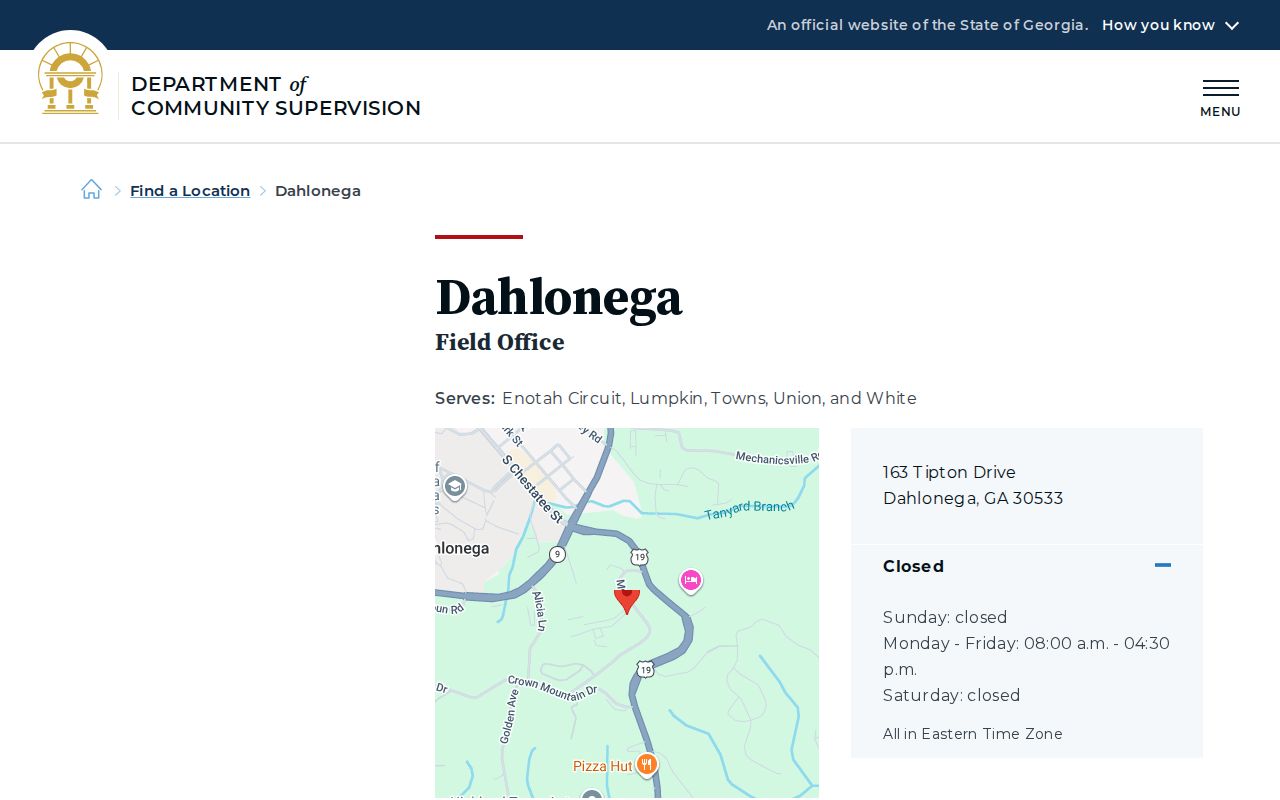
The office listing connects a released state prisoner or felony probationer to the Enotah Circuit field team rather than to the county jail.
Conditions, Violations, and Absconders
Conditions can require reporting, approved residence, travel permission, payment, treatment, testing, or compliance with special court and Board terms. A violation allegation does not itself prove revocation. The supervising officer reports conduct, while the court or Parole Board controls the legal outcome.
An absconder notation generally signals alleged loss of contact with supervision. A warrant or detainer can lead to arrest and may affect release from a later jail booking. Verify any warrant through the issuing authority. VINELink follows custody changes, not the full supervision case, so it may alert to a detention event without explaining the underlying violation.
How Lumpkin Supervision Ends
Supervision may end at sentence expiration, through formal discharge, after successful completion recognized by the responsible authority, or after a court or Board action changes the sentence. Leaving jail is not the same event. A person may be released from custody and remain on parole or probation for years afterward.
For proof, request or locate the document created by the responsible authority: a court order for probation, a Board record for parole, or a DCS confirmation of field supervision status. If a parole violation results in revocation, custody may resume. If supervision expires, the discharge record should be read separately from the earlier jail or prison release record.
Lumpkin Parole Meetings and Decisions
The Parole Board press-release page publishes operations meeting notices, agendas, cancellations, and videos. Those public meetings are not county-by-county hearings for individual offenders, and the Board says offender cases are not considered there. A published schedule described first-Tuesday meetings, but later notices show dates can vary or meetings can be canceled. Use TPM Lookup for an incarcerated person's tentative review month and Parolee Search after release. Decision guidelines explain the Board's factors, but they do not predict an outcome for one person.
Most parole-eligible Georgia inmates become eligible for consideration after serving one-third of the sentence. Eligibility is not release. Serious violent felony and life-sentence rules can delay or restrict consideration, and residence-plan verification or prison conduct can postpone a tentative month. Outcomes can include denial, reconsideration, a tentative month, postponement, a conditioned grant, revocation, or eventual discharge.
Lumpkin Parole Eligibility Is Conditional
The Georgia parole process automatically considers most eligible state prisoners. An application is usually not required. The Board weighs sentence information and its guidelines, but it keeps discretion to deny parole or set a tentative parole month before sentence expiration.
A tentative parole month is the month for final review, not a guaranteed exit date. Good conduct, completion of required programs, and verification of a residence plan may affect the result. Misconduct can postpone or cancel the month. Serious violent felony mandatory portions under O.C.G.A. 17-10-6.1 can restrict ordinary parole or earned-time reductions, and life sentences follow separate consideration rules.
Someone released from Lumpkin County Jail on bond never enters this process merely because the jail stay ended. Parole applies only when state confinement and Board authority are present. A court-ordered probation term instead begins with the sentencing court and field supervision route.
Verify Lumpkin Warrants Carefully
No separate official Lumpkin County absconder list was identified. If a person is alleged to have stopped reporting, verify the status through DCS, the Parole Board, the issuing court, or the Sheriff's official warrant and records channels. A social post or old roster entry cannot establish a current warrant.
A supervision violation can lead to a warrant, detention, preliminary review, and a final revocation decision. The outcome may be continued supervision, modified conditions, or return to custody. When the person appears in the jail again, the custody record may show a supervision hold, but the Board or court file explains the legal basis.
Georgia VINE may send a custody-change alert after an arrest. It does not contain the full probation or parole case. Confirm both the new custody event and the supervision action before treating the status as final.
Lumpkin Court Probation Records
The sentencing court is the primary source for probation terms. Lumpkin Superior Court handles felony files and can show a probation sentence, a split sentence with confinement followed by probation, later modifications, and revocation orders. The jail roster cannot replace that file once the custody event ends.
Dahlonega Municipal Court uses a different local route for city misdemeanor, traffic, and ordinance matters. Its page lists North Georgia Probation Services for municipal supervision questions. That provider should not be confused with DCS, which supervises felony probationers and parolees through the Dahlonega field office.
Read the sentence date, length, special conditions, credit for time served, and any later court order together. A release date identifies the end of custody, while the sentence identifies whether supervision began. If a later warrant or revocation appears, verify it in the same court file and with the supervising authority.
Lumpkin Supervision Record Boundaries
Parolee Search can identify a released person under Board supervision. TPM Lookup serves a person who remains incarcerated and has reached the parole-consideration process. Neither tool is a general county probation database. A negative result should lead back to the court and DCS rather than to a conclusion that no supervision exists.
Georgia VINE has another limited role. It can report participating custody changes and provide alerts, but it does not show the complete community-supervision history. The GBI Sex Offender Registry is also separate. It covers only people with a qualifying registration duty and is not proof of parole or probation for the general population.
Use the record created by the agency with authority: the Board for parole decisions, DCS for felony field supervision, the court for probation orders, and LCSO for a new jail event. This division keeps a release from being mistaken for discharge and keeps a custody alert from being mistaken for a supervision decision.
Public Record Search
Sponsored Results