
Projected vs Actual Release Date
A projected date is an estimate or sentence-based milestone. It is not proof that a person left custody. A pretrial detainee may leave after bond, a court order, dismissal, or transfer, so there may be no fixed calendar date at all. A person serving a county sentence may have a calculated completion date held by the jail or court. A state prisoner can have several dates, each with a different meaning.
Scheduled is not actual. Confirm the completed release through the jail release record, GDC status, or the receiving agency when a transfer is involved.
- MRD
- The maximum release date if the full GDC sentence is served without parole.
- TPM
- The tentative parole month for final Board review, not a promised release.
- Discharge
- The end of custody or supervision obligations under the applicable sentence.
Find Lumpkin Release Dates
Choose the source by custody type. Lumpkin's public inmate check shows current-custody details but does not publish a projected-release field. GDC covers state sentences, while the Parole Board supplies TPM information. Federal and immigration dates use separate systems.
- Check the official Lumpkin inmate portal to determine whether the person is still held locally.
- For a local sentence, call detention at 706-864-0412 and check the sentencing court. Request the booking and release record when a durable answer is needed.
- For a Georgia prison sentence, search the GDC Offender Query by name, GDC ID, or case number and match the conviction details.
- Check the Inmate TPM Lookup separately. A TPM does not replace the GDC date.
- Recheck the responsible agency close to the expected event and use the Lumpkin release-record process to confirm what occurred.
Good-Time Credit and How Release Dates Are Computed
Georgia does not use one universal percentage for every release. The Parole Board says most parole-eligible inmates become eligible for consideration after one-third of the prison sentence. Eligibility is only the point at which review may occur. It does not require the Board to grant parole. Life sentences, prior convictions, offense dates, and sentence structure can produce different review rules.
O.C.G.A. 17-10-6.1 restricts reductions for mandatory portions of serious violent felony sentences. By contrast, eligible GDC offenders may earn Performance Incentive Credits. GDC says PIC can provide one to twelve months off a TPM or MRD through qualifying case-plan, education, vocational, and work-detail achievements. PIC is not automatic county-jail good time and must not be applied to a Lumpkin detainee without agency confirmation.
Why a Projected Release Date Changes
A displayed month or date can move before release. The change may come from sentence administration, a court, the Parole Board, or another agency hold.
| Factor | Possible effect | Confirm with |
|---|---|---|
| PIC award or loss | May advance or restore time to a state TPM or MRD | GDC and Parole Board |
| Discipline or programs | May postpone or cancel a TPM | Parole Board |
| Residence plan | Can delay a parole release pending verification | Board and DCS |
| Detainer or hold | May turn release into transfer | Jail, GDC, and receiving agency |
| Court correction | Can change sentence credit or time served | Sentencing court |
A transfer is especially important. Leaving Lumpkin County Jail for GDC, USMS, ICE, or another county is not the same as release to the community. Ask for the receiving agency in the release record.
Confirming a Release Date
Because a projected date can change, an alert is most useful when it is registered before the event. Georgia VINE can send a notice after a participating custody status changes. Search the exact person, verify the facility, select the notification option, and retain the four-digit PIN used for phone alerts or account changes. The Lumpkin VINELink inmate search explains that process.
VINE is not a permanent date archive, and it does not replace BOP or ICE. After a notice arrives, compare it with the official jail release record, the GDC offender result, or the receiving agency. That final check distinguishes release from transfer and confirms the actual date rather than the earlier estimate.
Georgia Dates for Lumpkin Prisoners
The GDC Find an Offender page says its records can show facility location, charges, and a release date. Search by name first, then refine with GDC ID, case number, age, or conviction facts. A photo may display automatically when available, so verify the record before drawing conclusions.
A listed facility location shows that GDC custody continues. A release date on a state record belongs to the state sentence and does not establish when the earlier Lumpkin jail booking ended. The county exit may have been a transfer into GDC custody. Request the local release record when both dates are needed.
The official GDC Performance Incentive Credit page explains one way eligible state dates may move.
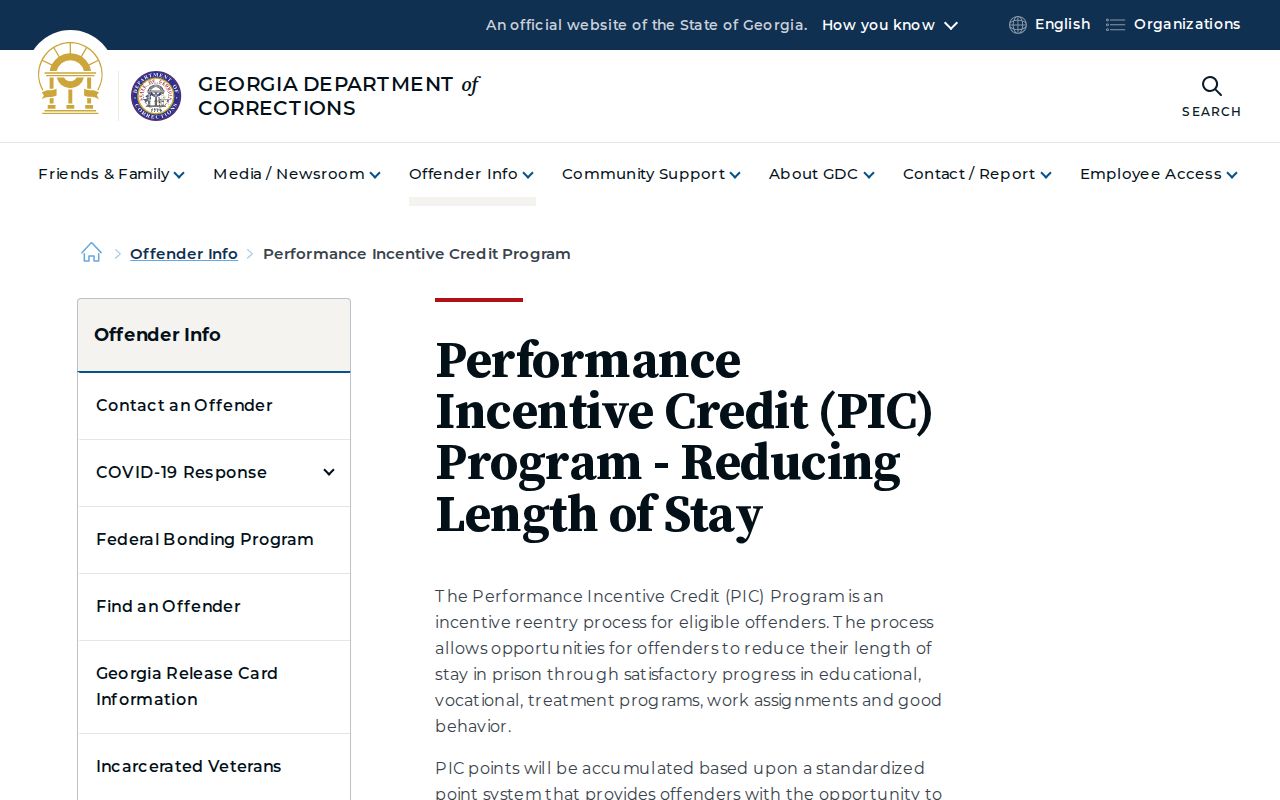
The GDC source confirms that Performance Incentive Credit is a state corrections framework, not a general credit rule for every person housed at Lumpkin County Jail.
Lumpkin MRD and TPM Differences
Georgia Rule 125-2-4 defines Maximum Release Date as the date an inmate would leave Department of Corrections custody after serving the whole sentence, apart from parole decisions. Life and death sentences have no MRD under that definition. The MRD is therefore a sentence endpoint, not a prediction that parole will occur on an earlier date.
The TPM is a Tentative Parole Month. It marks the Board's expected final review period and can lead to a parole date only if the Board approves release and required conditions are met. Conduct, programs, and residence-plan verification can affect the outcome. A TPM should never be printed as an actual release date.
| Date | What it means |
|---|---|
| County jail completion | Local sentence or court-controlled custody endpoint |
| MRD | Full GDC sentence endpoint excluding parole |
| TPM | Tentative month for Board final review |
| Parole release date | Date set after Board action and final conditions |
| Actual release date | Recorded date custody ended or transferred |
No Universal Georgia 85 Percent Rule
Georgia release-date computation cannot be reduced to a single percentage. The Parole Board states that most parole-eligible inmates reach eligibility after one-third of the sentence, but eligibility only opens review. Serious violent felony mandatory portions can bar parole, earned time, early release, and similar reductions under O.C.G.A. 17-10-6.1.
For eligible state offenders, the PIC program allows up to twelve points and may move a TPM or MRD by one to twelve months. Credits can be tied to reentry case plans, education, vocational work, or detail assignments. They depend on eligibility and agency decisions.
A local Lumpkin sentence requires the court order, jail calculation, applicable law, and any approved local credit. Do not apply the GDC PIC formula to a county detainee. Likewise, do not apply a state parole estimate to someone awaiting trial, since bond and court action control that person's release path.
Lumpkin Pretrial Dates Depend on Court
A person awaiting trial has no sentence endpoint to calculate. Release may follow posted bond, recognizance, dismissal, a court order, or another custody decision. The date depends on when the legal requirement is satisfied and when the jail completes processing, not on an MRD or TPM.
Check the Lumpkin inmate portal for current custody, then contact the detention line and the court that controls the case. Superior Court covers felony files. Magistrate Court handles warrant applications, good-behavior bonds, ordinance matters, and certain misdemeanors. Dahlonega Municipal Court handles city misdemeanor, traffic, and ordinance cases.
If a bond order exists, it still does not prove that bond was posted or that all other holds cleared. Ask LCSO whether another agency hold remains. A federal, immigration, state, or other-county hold can turn the expected local exit into a transfer.
Lumpkin Sentence Credits Need Records
For a local sentence, use the signed court order and the jail's own calculation. Ask how credited time served was applied and whether any lawful local credit changed the endpoint. Research did not identify a public Lumpkin portal field that displays a calculated county release date, so no online estimate should be substituted for the agency record.
For a state sentence, compare the GDC result with the sentencing file. Sentence corrections, additional cases, disciplinary action, program completion, and Board decisions can change the dates a user sees. When dates conflict, note when each record was checked and ask the responsible agency which calculation is current.
The release record closes the loop after the event. It should distinguish the actual date and reason from an earlier projection. If the person moved to parole, verify the field office through DCS. If the person moved to another jail or federal authority, verify the receiving agency instead.
Lumpkin Federal Release Dates Differ
Federal sentences do not use the GDC or Georgia TPM systems. Search BOP for a sentenced federal prisoner. BOP explains that a past release date with no facility location means the person is no longer in BOP custody, though another legal status can exist. Federal dates can also be recalculated, so recheck close to the event.
A person held for the U.S. Marshals may not yet appear as a designated BOP prisoner. In that case, use the federal court and USMS record routes. ICE's locator addresses current or recent immigration custody and does not calculate a Lumpkin County release date.
If the county release record names a federal or immigration recipient, describe the event as a transfer from Lumpkin custody. Do not treat the county exit as release to the community unless the receiving agency record supports that conclusion.
Public Record Search
Sponsored Results