
Understand Lumpkin County Releases
Release means that one custody event ended. It does not always mean the person is free of every hold, sentence, or court obligation. Someone may bond out while a criminal case remains open, finish a short local sentence, leave under a court order, begin probation, or move from the county jail to another agency. The Lumpkin Sheriff documents the county booking. GDC records a later state-prison discharge. The Parole Board and Department of Community Supervision document release to community supervision.
The public Zuercher portal is built around people who are in custody or were in custody on a selected date. Once a person leaves the active jail population, absence becomes a lead rather than proof. A transfer to GDC, another county, USMS, or ICE can look like a release from Lumpkin even though custody continues. The release reason and receiving-agency fields resolve that ambiguity.
Routes Out of Lumpkin Custody
The route out determines where the next reliable record appears. Bond and court-order releases remain tied to the court case. Sentence completion is tied to the jail or GDC calculation. Transfers point to the receiving agency.
| Release type | Meaning | Next record |
|---|---|---|
| Bond or recognizance | County custody ends while the case continues | Jail release sheet and court bond order |
| Time served | The local sentence or credited time is complete | Sentence and jail release record |
| Probation | A court sentence is served in the community | Court and DCS or municipal probation |
| Parole | State confinement ends under Board supervision | GDC, Parolee Search, and DCS |
| Transfer | Lumpkin custody ends but another agency takes custody | Receiving county, GDC, BOP, USMS, or ICE |
Lumpkin Release Record Fields
A narrow request should identify the booking and ask for the operational facts that ended it. Not every field is public in every case, but the following inventory gives the records specialist a clear scope.
| Field | What it shows |
|---|---|
| Booking number and dates | The custody event tied to the correct person |
| Charges and hold reasons | Why the person was confined at release |
| Release date and time | When county custody ended |
| Release reason | Bond, order, completion, dismissal, transfer, or another cause |
| Bond details | Amount and cash, surety, or property indicator when applicable |
| Receiving agency | Whether the person moved to GDC, federal, immigration, or other custody |
A court file supplies the legal cause behind many of these fields. A GDC result supplies state sentence and discharge information. Neither should be substituted for the other.
Request Lumpkin Release Records
The county warns that its general clerk form is not for Sheriff's Office records. Use the LCSO open-records route. Christina Wise is the Sheriff's Office Open Records Specialist at 706-482-2634 and christina.wise@lumpkincounty.gov.
- Give the full name, date of birth if known, and an approximate booking date.
- Ask for the booking and release record, including release date, time, reason, bond details, holds, and receiving agency.
- Request segregable, non-exempt portions if part of the record is withheld.
- Review the cost estimate. The first fifteen minutes are not charged, and ordinary copies are generally ten cents per page.
- Expect notice within three business days about availability and estimated cost, not necessarily final production in three days.
Some results may be limited by Georgia record restriction under O.C.G.A. 35-3-37, a court order, or another exception. Restriction does not promise deletion from every operational system.
The official county instructions show why routing matters. The County Clerk accepts many county requests, but the page sends Sheriff's Office requests to the Sheriff's own custodian and sends court-file requests to the Clerk of Court. A jail release sheet belongs with LCSO. A bond order or criminal disposition belongs with the court that entered it. Asking one office for both can delay the answer or produce only half of the needed record.
The Lumpkin County open-records page displays the local response and fee policy used for a Sheriff's request.
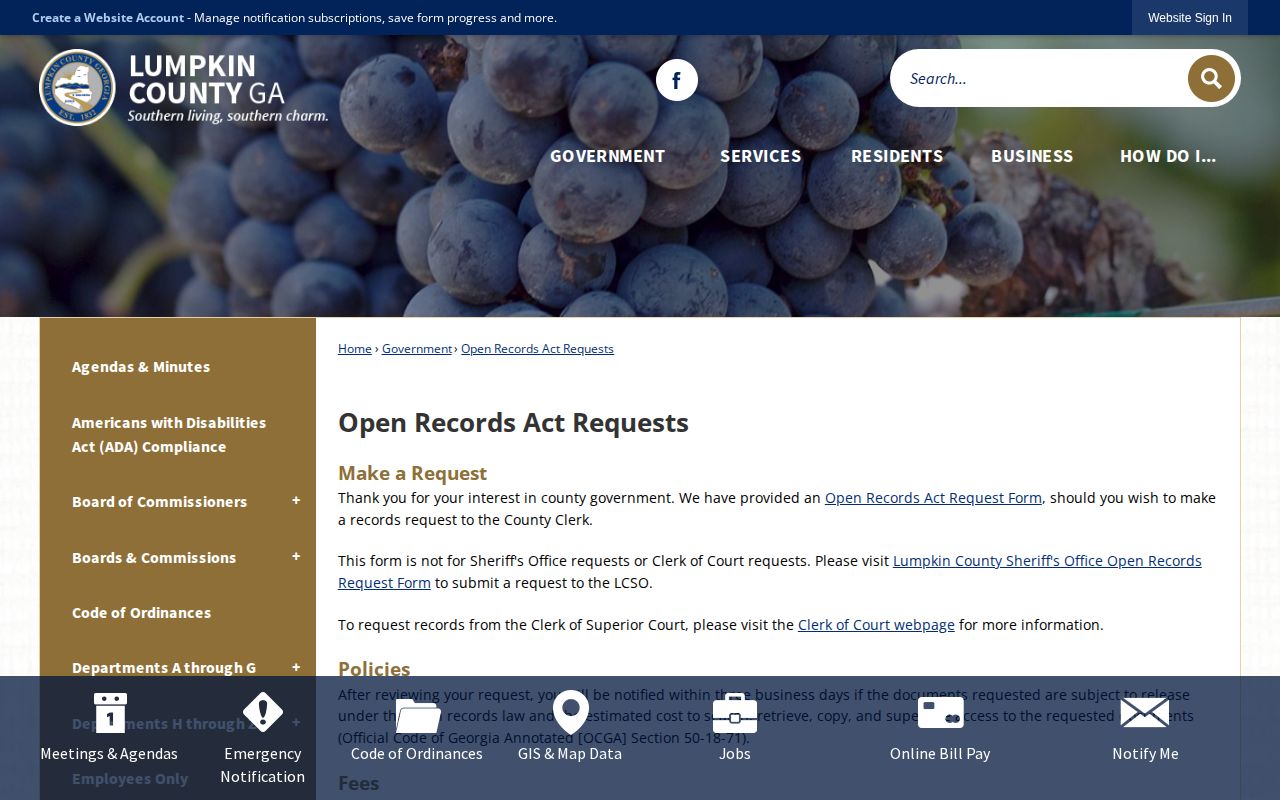
That routing page is the best starting point when the live inmate check no longer shows the person and an official date, time, reason, or transfer destination is needed.
Georgia Law on Release Records
O.C.G.A. 50-18-70 states Georgia's policy favoring prompt public access and broadly defines records, including electronic data fields and photographs. Fees and production rules appear in O.C.G.A. 50-18-71 and the county policy. Exceptions are applied to particular material, so a precise request helps the custodian release what can lawfully be produced.
A missing public result can reflect release, transfer, a name mismatch, retention limits, or a restricted record. It does not prove any one outcome.
Find Released Lumpkin Inmates
Start with custody, not a broad name search. Each system covers a different legal status.
- Search the official inmate check and note the arrest date, cell block, holds, and in-custody status.
- If the name is gone, call detention at 706-864-0412. A phone answer helps with a same-day change but is not a certified record.
- Check Superior, Magistrate, or Dahlonega Municipal Court for the order, bond, plea, sentence, or disposition.
- Search GDC if the person may have entered state custody, then check parole or probation tools.
- Use BOP or ICE where the jail record suggests federal or immigration transfer.
- Submit the focused LCSO records request for final county release details.
The 24-hour Lumpkin release workflow addresses recent changes, while projected release dates concern future sentence milestones.
GDC Search for Lumpkin Releases
Use the Georgia Department of Corrections Offender Query when a Lumpkin case became a state sentence. Search by name first, then refine with GDC ID, case number, race, sex, age, or conviction information. Match more than the name. A county detainee who was never sentenced to GDC may not appear.
| Search clue | Use |
|---|---|
| GDC ID | Best direct identifier |
| Case number | Connects the state record to the court matter |
| Name and age | Starts a search but needs corroboration |
| Conviction county and offense | Separates similar names |
| Status and release date | Shows state custody or discharge, not county release |
The GDC explanation page identifies facility, charge, and release-date lookup. A facility location indicates continued GDC custody.
Lumpkin Recent Release Limits
No official named 24-hour or 72-hour release feed was found. The configured public portal shows name, race, sex, age or date-of-birth presentation, cell block, arrest date, hold reasons, and an “In Custody On” filter. Release date and mugshot columns were not enabled in the observed local view. The county also does not publish a refresh cadence or a public retention period for released entries. Do not treat absence as a time-stamped release. Call, check court, and request the record.
The date filter answers a narrower question: whether the portal data places a person in custody on a selected day. It does not create a list of everyone released during that day. Likewise, an arrest date is not a release date. For a change that occurred moments ago, the detention line may be the fastest check. For a durable answer, the release record and related court order are stronger because they preserve the event after the public current-custody view changes.
Parole and Probation After Release
Parole is release from a state prison sentence under Board authority. Probation is a court sentence served in the community. DCS supervises both felony parolees and probationers, and its Dahlonega office serves Lumpkin County at 163 Tipton Drive. Use the Parolee Search for a released parolee and DCS for the supervising office. Municipal probation named by Dahlonega Municipal Court is separate from felony DCS supervision. The Lumpkin probation and parole page provides the full verification path.
Release Notifications and Federal Releases
Georgia VINE is best used before release to follow one person and receive a custody-change notice. It is not a permanent historical archive. Register the correct record, select the available phone, email, text, app, or TTY method, and retain the four-digit PIN. For federal sentences, use the BOP locator. BOP says a past release date with no facility usually means the person is no longer in BOP custody. Use ICE's locator for an immigration lead. A county record that says USMS or ICE should be read as a possible transfer until the receiving system confirms otherwise.
These channels should be checked in sequence, not blended together. VINE follows participating custody data and sends a notice when status changes. BOP covers federal prisoners from 1982 forward. ICE searches current or recent immigration custody by A-number or identifying information. USMS may handle a federal pretrial transfer without creating a BOP sentence record at that moment. If one locator is blank, return to the Lumpkin release record and look for the exact receiving agency before drawing a conclusion.
Released vs Still in Custody: Where to Look
The right source follows the legal custodian.
| System | Best for | Not proof of |
|---|---|---|
| Lumpkin inmate check | Current or date-filtered county custody | Official release reason |
| LCSO release record | When and why the county booking ended | End of another agency's custody |
| GDC offender search | State facility, sentence, and discharge status | Local bond release |
| Court file | Bond, disposition, sentence, and orders | Live physical location |
| BOP or ICE | Federal or immigration custody | County release to the community |
Lumpkin Release Channels
The Lumpkin County Jail is the local detention facility. Dahlonega Police and University of North Georgia Police are arresting channels whose booked detainees generally enter county custody. GDC is the statewide prison and discharge channel. BOP, USMS, and ICE require separate federal or immigration checks. No state prison, BOP prison, or ICE detention center was identified as physically located in Lumpkin County.
The facility map therefore contains five different kinds of release path. The Lumpkin County Jail page covers a local booking and the Sheriff's release record. The Dahlonega Police page follows a city arrest into either Municipal Court or county jail custody. The University of North Georgia Police page follows a campus arrest into the county booking and court process. The GDC page covers people sentenced from Lumpkin to the statewide prison system. The federal page separates BOP sentences, USMS holds, and ICE detention or detainers. Choosing the page by custodian prevents a local roster from being mistaken for a state or federal release archive.
Courts Explain Lumpkin Releases
Superior Court felony files can contain bond orders, pleas, sentences, revocations, and final dispositions. Magistrate Court handles warrant applications, good behavior bonds, county ordinance matters, and certain misdemeanors. Dahlonega Municipal Court handles city misdemeanor, traffic, and ordinance cases. These layers explain many releases after a jail listing drops. Criminal eFiling became available in 2020, and Lumpkin Superior appears in Georgia's e-access list through PeachCourt. A court disposition should be reconciled with the jail release record because one describes legal authority and the other documents the custody event.
Start with the court named on the charge or booking. The Lumpkin Clerk of Superior Court maintains criminal files for the courts it serves at 325 Riley Road, Room 108, and lists weekday hours from 8 a.m. to 5 p.m. Magistrate Court is in Room 109 at the same street address and provides a separate criminal phone line. Dahlonega Municipal Court sits at City Hall and meets monthly for city matters. These are not interchangeable offices. A city traffic disposition will not be found in a GDC offender record, while a felony state sentence may continue from Superior Court into GDC and later parole records.
A bond order can authorize the jail to release a person, yet it does not show the exact time jail staff completed processing. Conversely, the jail release entry can show when custody ended without explaining every term imposed by the judge. Reading both records answers the practical question and the legal one. If a person was moved instead of freed, the release record should identify a receiving agency that points to the next custody search.
Lumpkin Work Detail Is Not Release
Historical county public-works reports include inmate detail logs and “County Jail Return” entries. They show that movement to a road or trash-pickup detail was recorded separately from return to the jail. Those older records do not establish current policy. They do establish a useful caution: “out on detail,” transported, or temporarily away from a housing area does not mean released. Only the release record or receiving-agency record confirms the end of custody.
The distinction also applies to court trips, medical movement, and agency transport. A person can be outside a cell block while the Lumpkin County Jail remains the legal custodian. The current portal's cell-block field is therefore a housing clue, not a release certificate. Historical work-detail records should be used only to understand that difference. They should not be used to infer that a present-day person is on a detail or that the old road-department practice remains in effect.